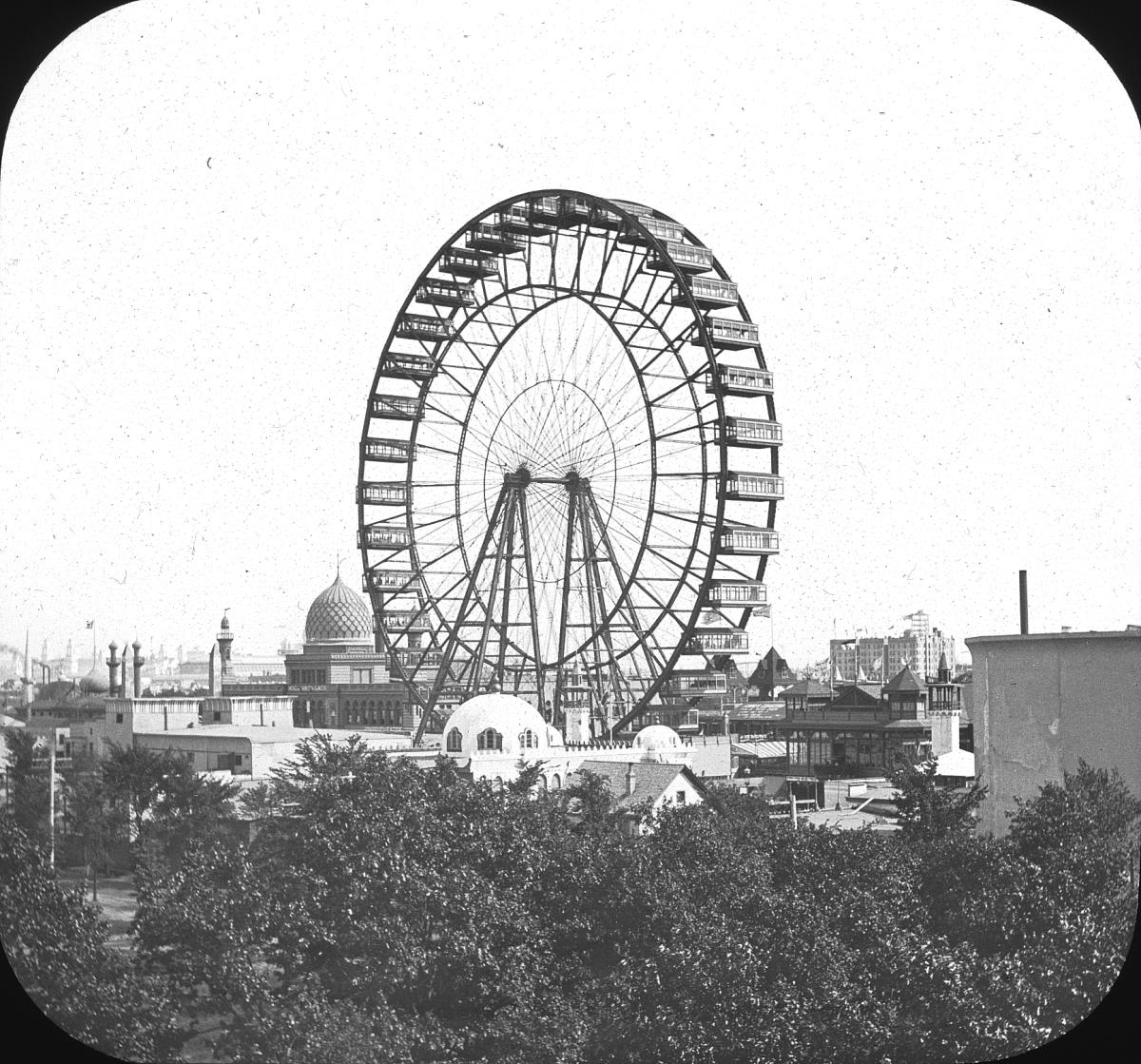
The original Ferris Wheel rising above the buildings of the 1893 World's Columbian Exposition in Chicago

1837–1906

A Ferris Wheel Timeline

A sourced chronology of the family, the engineer, and the original Wheel. Entries that rest on disputed evidence keep both sides. Held claims are omitted.

Starks W. Lewis · 1893Brooklyn Museum Archives via Wikimedia Commons · No known copyright restrictionsScroll

Galesburg and Knox College founded

Knox College's 1912 anniversary history names Silvanus Ferris among the first trustees and the purchasing committee; the family record places him among the Galesburg founders with the Rev. George Washington Gale.[1][2, p. 22 and plate caption][3]

Knox College's own 1912 anniversary history names Silvanus Ferris among the first trustees elected on 7 January 1836, when the subscribers accepted the purchasing committee's report, and its plate captions identify him as a member of that purchasing committee.[1][2, p. 22]

George Sr. buys the Third Street house in Carson City

the family home at Third and Division Streets in Carson City, listed on the National Register in 1979 as the G. W. G. Ferris House and now known as the Sears–Ferris House[1][4, Item 8; NRIS record 79003438][8, Section 8][9, p. 3]

Gregory Alvin Sears built the house at 311 West Third Street, Carson City, in 1863: assessment rolls show bare land in 1862–63 and a $2,000 improvement the next year; the 1863 city directory lists him on 'Third near Nevada'.[8, Section 8][9, p. 3]

G. W. G. Ferris Sr. purchased the Third Street property (Block 28, lots 2 and 3) on 10 March 1868; he first appears on the assessment rolls for it on 31 December 1868, taxed for the land with dwelling house.[8, Section 8]

George Jr. is sent to school in Oakland

George Jr. was sent away to school at fourteen and attended a military academy in Oakland, California, before entering Rensselaer Polytechnic Institute in 1876.[4, Item 8][5, pp. 515–516][7, p. 50][7, p. 64]

George Sr. moves to Riverside, California

The family record says George Sr. settled at Riverside about 1880, after his nephew had secured Magnolia Avenue land for him in 1879; later local notices use 1881–82 for the colony's Ferris houses.[1][10]

The Henderson Bridge opens

Nason's 1887 register and Weingardt both place him on the Henderson Bridge over the Ohio (1883–85), first on its foundations and then inspecting its steel in Pittsburgh; the National Register nomination likewise records his turn to bridge building and steel inspection.[4, Item 8][5, pp. 515–516][7, pp. 51–54]

G. W. G. Ferris and Company founded in Pittsburgh

In 1886, aged twenty-seven, he founded G. W. G. Ferris and Company, Consulting and Inspecting Engineers, in Pittsburgh, to test and inspect steel and other metals for large structures; James C. Hallsted was his first partner and the firm's first office was on Grant Street.[4, Item 8][5, pp. 515–516][6, pp. 32–34][7, p. 55]

Marries Margaret Ann Beatty at Canton, Ohio

His partners' 1897 memorial and Weingardt both date the marriage to Margaret Ann Beatty of Canton, Ohio, to 18 September 1886; the National Register nomination names her as his surviving wife.[4, Item 8][6, pp. 32–34][7, p. 57][7, p. 67]

Burnham challenges the engineers

Luther Rice's 1901 account places Burnham's challenge at an engineers' luncheon early in 1891; the Carson City nomination gives 1892.[7, pp. 70–72][11, pp. 475–480]

The Central Bridge at Cincinnati opens

With Gustave Kaufman he formed Ferris, Kaufman & Company in 1889; the Engineers' Society of Western Pennsylvania records the Ninth Street Bridge in Pittsburgh as theirs, and Weingardt adds the Central Bridge at Cincinnati (opened 1 September 1891).[6, pp. 32–34][7, pp. 60–67][12]

Ferris presents the Wheel

Rice's 1901 account, matching the Chicago Tribune of 18 June 1893, has a concession granted in June 1892 and revoked the next day. Weingardt adds the committee's reluctance and the 'spider web' wind doubts.[7, pp. 76–77][11, p. 476][13, p. 25]

Ferris Wheel Company formed

The Chicago Tribune of 18 June 1893 reported the Ferris Wheel Company capitalised at $600,000. Rice names Hunt as president and Vincent as secretary at the opening. Following Anderson, Weingardt dates incorporation to 9 June 1892 and a Pittsburgh Construction Company to 14 November; those filing dates have not been independently read.[7, p. 78][11, p. 478][13, p. 25]

Ferris signs the agreement with the Exposition

Rice and Ferris's own 1893 account date the board's concession to 16 December 1892, less than four months before the fair opened; Weingardt dates a formal agreement to 29 November.[7, pp. 79–81][11, pp. 475–480][14, p. 2]

Fifty cents for two revolutions is independently in the 1893 guidebook and the 18 June Tribune. Rice has the 16 December concession letting the company keep the first $300,000 from tickets, then half the gross to the Exposition. The Tribune instead has half after receipts equalled 'the cost of the wheel'. Weingardt treats $300,000 as a construction-cost cap and adds a sixty-day removal term not yet independently read.[7, pp. 80–81][7, p. 116][11, p. 476][13, p. 25][15]

The board issues the concession

Rice and Ferris's own 1893 account date the board's concession to 16 December 1892, less than four months before the fair opened; Weingardt dates a formal agreement to 29 November.[7, pp. 79–81][11, pp. 475–480][14, p. 2]

Detroit Bridge and Iron Works contract announced

On 22 December 1892 the Associated Press, from Detroit, announced the Detroit Bridge and Iron Works as contractor to construct the Wheel for $300,000.[16, p. 5 (Associated Press, Detroit)][17, p. 3]

First tower post placed

Rice dates the first tower post to 20 March 1893; the 18 June Tribune dates the start of scaffolding to the same day. Weingardt has the first tower completed on 20 March and the structure, minus cars, complete about 1 June — that completion date has not been independently read.[7, p. 84][11, p. 477][13, p. 25]

Rice's 1901 account, matching a Chicago Citizen feature of 12 August 1893, describes thawing frozen quicksand with live steam to sink the foundations from January 1893.[7, p. 83][11, pp. 475–480][21, p. 5]

The Wheel turns for the first time

The first revolution came at six o'clock on the evening of 9 June 1893, as Rice telegraphed Ferris and Ferris confirmed the next day.[7, p. 85][22]

Garden City patent suit

Weingardt records the Garden City company's patent suit being served the day after the opening, with Ferris's first deposition on 10 July. A matching National Archives file has been located and not read; the service date is not independently confirmed.[7, pp. 93–94][26][27]

Weingardt has the Garden City patent suit dismissed on 3 July 1894 with $26.50 costs to Ferris, and states that Ferris never patented the Wheel. A 23 November 1893 New Jersey paper reported that the highest court had found infringement and royalties due. The case file has been located and not read; the outcome stays in dispute.[7, p. 107][7, p. 96][26][27][28, p. 3]

The Wheel rides out a gale

The Wheel came through a severe storm on 9 July 1893. Syndicated reports said it did not move 'a hair's breadth'; a letter in Engineering News, via Weingardt, gave about an inch and a half of sideways movement.[7, pp. 93–94][29, p. 1, syndicated][30]

Ferris family reunion at Lake George

The family record and Weingardt agree that his parents visited the fair and, on 5 September 1893, a reunion of some sixty Ferrises at Lake George near Galesburg.[1][7, p. 98]

Receipts pass $300,000

1,453,611 paid admissions, the figure the company's stockholders reported in November 1893. Gross-receipts figures in later accounts range from about $727,000 to 'more than $750,000'.[7, pp. 94–95][7, p. 104][30][31][32]

Ferris said receipts passed $300,000 on 8 September 1893. Contemporary press put construction cost at $392,000; Weingardt, following the later lawsuit, gives $362,000.[7, p. 80][14, p. 2][30]

Chicago Day

Rice gives 34,433 paid admissions on Chicago Day, 9 October 1893; Searles, writing in November 1893, gives 34,451 as the largest day. Weingardt's about 10,000 riders a day, and 750,000 fair attendance that day, have not been independently read.[7, p. 72][7, p. 102][11, p. 479][20, pp. 618–619]

The Exposition closes

The fair closed on 30 October 1893, its ceremonies muted by the assassination of Mayor Harrison two days earlier (Weingardt, pp. 100–102).[7, pp. 100, 102]

The authorised history of the Exposition quotes the enabling act: dedication 12 October 1892, open by 1 May 1893, close not later than 30 October 1893, and names Harlow N. Higinbotham among the officers of the board of directors.[33]

The Exposition forces the Wheel closed

On 1 November 1893 Exposition guards tried to close the Wheel. A contemporary report quotes Ferris refusing to pay $75,000 and intending to run until 30 November; lawsuits followed both ways.[7, pp. 100–101][34, p. 2]

A contemporary report quotes Ferris refusing a $75,000 Exposition demand in early November 1893. Weingardt dates the Exposition's suit for that sum to 9 November. The filing date has not been independently read in a court record.[7, p. 104][7, p. 116][34, p. 2]

The Wheel is dismantled

Weingardt records the Wheel dismantled in spring 1894 for $14,833 and stored on rail cars.[7, p. 106]

Ferris Wheel Park on North Clark Street

Weingardt traces the Wheel's re-erection at North Clark Street in 1895–96 and the neighbourhood opposition; the Illinois courts' own history records the 1896 Supreme Court ruling that kept the park from selling liquor.[7, pp. 108–111][35]

The Illinois courts' own history records that the Supreme Court denied the Ferris Wheel Company a dram-shop permit for the Clark Street park in 1896; the exact reporter citation is still being checked.[7, pp. 108–111][35]

Weingardt records the company bankrupt by November 1896; the Hyde Park Historical Society reprints the Tribune's 1903 note of an $1,800 receiver's sale.[7, pp. 111, 118][32]

George Sr. dies at Riverside

George Sr. died at Riverside, California, on 20 April 1895, and Martha on 23 March 1897; both rest at Olivewood Cemetery (family record, quoting the 1895 Galesburg obituary; Weingardt).[1][7, p. 109][7, p. 116]

The Ferris Wheel Company goes into receivership

Weingardt records the company bankrupt by November 1896; the Hyde Park Historical Society reprints the Tribune's 1903 note of an $1,800 receiver's sale.[7, pp. 111, 118][32]

George Ferris dies

He died of typhoid fever at Mercy Hospital, Pittsburgh, on 22 November 1896, aged 37. (The family record gives 28 November, the date of the trade-journal issue that carried his obituary; every other source read gives the 22nd.)[4, Item 8][6, pp. 32–34][7, pp. 111–112][36, p. 1][37, p. 3 (dateline Pittsburg, 22 Nov.)][38, p. 6][39][40]

He was cremated after a service on 24 November 1896. Papers in 1898 reported the ashes still held at Samson's crematory for unpaid claims; the family record itself says they are unaccounted for.[1][7, pp. 114–115][41, p. 2][42, p. 6]

Pittsburgh and out-of-town papers in 1898 reported the ashes still held at Samson's crematory for unpaid funeral claims, more than a year after the 24 November 1896 service. The family record still says they are unaccounted for.[1][7, pp. 114–115][41, p. 2, 'Ferris' Ashes Held for Debt'][42, p. 6, 'Ashes Held for a Debt']

Judgment for the Exposition

Two months after Ferris's death, Weingardt records, the court gave the Exposition an $84,000 judgment against the company.[7, p. 116]

The Wheel is sold for salvage

Sold to the Chicago House Wrecking Company in 1903, the Wheel was moved by rail to St. Louis for the 1904 fair. Harris's later study gives 175 freight cars; a St. Louis library article gives 178.[4, Item 8][7, pp. 118–119][43, pp. 1, 4–9][44, pp. 2–7]

The 1903 salvage sale is reported as $1,800 in a Chicago Tribune item of 3 June and as $8,150 in later St. Louis summaries of 7 June; both figures stay on the page until the original notices are compared.[7, pp. 118–119][32][44, pp. 2–7]

The Wheel at the Louisiana Purchase Exposition

Sold to the Chicago House Wrecking Company in 1903, the Wheel was moved by rail to St. Louis for the 1904 fair. Harris's later study gives 175 freight cars; a St. Louis library article gives 178.[4, Item 8][7, pp. 118–119][43, pp. 1, 4–9][44, pp. 2–7]

The Wheel ran at the 1904 St. Louis fair. Company-family papers later published by Leo Harris give 175 freight cars and $267,000 gross; Weingardt had $215,000 and 'over a million' riders. A St. Louis library summary says 178 cars.[7, pp. 118–119][43, pp. 1, 4–9][44, pp. 2–7]

The Wheel's last revolution

A St. Louis County Library summary, following local papers, dates the last revolution to 13 January 1906, with three people aboard.[7, p. 120][44, pp. 2–7]

Sources

Numbered in order of first use along the chronology. A date is only as firm as the claim it cites.

  1. Ferris Family Archive — Ferris Families of Knox County, IllinoisJames G. Ferris · October 12, 2022 editionrecord 1 · lineage (5.1.1.5.4); record 760 · lineage (5.1.1.5.4.9); record 986 · lineage (5.1.1.5.4.9.9); record 214 · lineage (5.1.1.5.4.2.1)About this collection · Open the record in the Ferris Archive (registered readers)
  2. Martha Farnham Webster, Seventy-Five Significant Years: The Story of Knox College, 1837–1912 (Galesburg: Wagoner Printing Co., 1912)Knox College (published for its seventy-fifth anniversary) · 1912Cited at p. 22 and plate caption; p. 22Public domain
  3. National Register of Historic Places Inventory–Nomination Form: G. W. G. Ferris House, Carson City, Nevada (reference 79003438)Barbara Levy and Wilbur Wieprecht, Nevada Division of Historic Preservation and Archeology · 1978-11-27 · National Park Service, NPGalleryCited at Item 8, Statement of Significance; Item 8, quoting S. Allen Chambers Jr. (HABS); Item 8; NRIS record 79003438; Item 8Public domain
  4. Circles in the Sky: The Life and Times of George FerrisRichard G. Weingardt · 2009 · ASCE Press (American Society of Civil Engineers)Cited at p. 60; p. 127; p. 50; p. 64; p. 48; p. 125; pp. 51–54; p. 55; p. 57; p. 67; pp. 70–72; pp. 60–67; pp. 76–77; p. 78; pp. 79–81; pp. 80–81; p. 116; p. 74; p. 83; p. 84; p. 85; pp. 88–92; pp. 93–94; p. 107; p. 96; p. 98; pp. 94–95; p. 104; p. 80; p. 72; p. 102; pp. 100, 102; pp. 100–101; p. 106; pp. 108–111; pp. 111, 118; p. 109; pp. 111–112; pp. 114–115; pp. 118–119; p. 120
  5. National Register amendment: Sears-Ferris House, Carson City, Nevada (reference 79003438)Mella Rothwell Harmon and Guy L. Rocha, Nevada State Historic Preservation Office / Nevada State Archives · 2000-07-15 · National Park Service, NPGalleryCited at Section 8Public domain
  6. The Carson Daily Appeal (Carson City, Nev.), 29 April 1870, p. 3: G. W. G. Ferris's fruit and shade treesChronicling America, Library of Congress · 1870-04-29Cited at p. 3Public domain
  7. 'The Great Ferris Wheel', The Mason County Journal (Shelton, Wash.), 27 October 1893, p. 2Chronicling America, Library of Congress · 1893-10-27Cited at p. 2Public domain
  8. 'To Revolve With 2,150 Persons', The Evening World (New York), 22 December 1892, p. 5 (Associated Press, Detroit)Chronicling America, Library of Congress · 1892-12-22Cited at p. 5 (Associated Press, Detroit)Public domain
  9. 'The Ferris Wheel', Morning Appeal (Carson City, Nev.), 21 December 1892, p. 3Chronicling America, Library of Congress · 1892-12-21Cited at p. 3Public domain
  10. 'For the Big Ferris Wheel', New-York Tribune, 20 March 1893, p. 2 (dateline Bethlehem, Pa., 19 March)Chronicling America, Library of Congress · 1893-03-20Cited at p. 2Public domain
  11. William H. Searles, 'The Ferris Wheel', Journal of the Association of Engineering Societies, vol. 12 (1893), pp. 614–621 (read 14 November 1893)William H. Searles, Civil Engineer's Club of Cleveland · 1893-11-14 · Board of Managers of the Association of Engineering SocietiesCited at p. 616; pp. 618–619Public domain
  12. 'The Triumph of Engineering', The Wilmington Daily Republican (Wilmington, Del.), 22 June 1893, p. 2Chronicling America, Library of Congress · 1893-06-22Cited at p. 2, 'The Triumph of Engineering'Public domain
  13. 'The Wheel Goes Round', The Beatrice Daily Express (Beatrice, Neb.), 22 June 1893, p. 1Chronicling America, Library of Congress · 1893-06-22Cited at p. 1, 'The Wheel Goes Round'Public domain
  14. 'Great Ferris Wheel in Midway Plaisance Opened to the Public', St. Paul Daily Globe, 22 June 1893, p. 5Chronicling America, Library of Congress · 1893-06-22Cited at p. 5Public domain
  15. Garden City Observation Wheel Company v. The Ferris Wheel Company, U.S. Circuit Court, Northern District of Illinois, Case 22941 (depositions from 10 July 1893)1893–1894Public domain
  16. Syndicated storm report, 10 July 1893 (St. Paul Daily Globe, Omaha Daily Bee, Daily Public Ledger, Helena Independent, p. 1 each)Chronicling America, Library of Congress · 1893-07-10Cited at p. 1, syndicatedPublic domain
  17. The Dalles Times-Mountaineer, 10 November 1893, page 1Chronicling America, Library of Congress · 1893-11-10Public domain
  18. Obituary report, Kansas City Daily Journal, 23 November 1896, p. 1Chronicling America, Library of Congress · 1896-11-23Cited at p. 1Public domain
  19. Obituary report, The San Francisco Call, 23 November 1896, p. 3 (dateline Pittsburg, 22 Nov.)Chronicling America, Library of Congress · 1896-11-23Cited at p. 3 (dateline Pittsburg, 22 Nov.)Public domain
  20. Obituary report, Rock Island Argus, 23 November 1896, p. 6Chronicling America, Library of Congress · 1896-11-23Cited at p. 6Public domain
  21. The Engineering and Mining Journal, vol. 62 no. 22, 28 November 1896Internet Archive scan via Wikimedia Commons · 1896-11-28Public domain
  22. Pittsburgh water and typhoid history (NCBI Bookshelf)National Center for Biotechnology Information
  23. 'Ferris' Ashes Held for Debt', Evening Star (Washington, D.C.), 28 February 1898, p. 2Chronicling America, Library of Congress · 1898-02-28Cited at p. 2; p. 2, 'Ferris' Ashes Held for Debt'Public domain
  24. 'Ashes Held for a Debt', Kansas City Journal, 9 March 1898, p. 6Chronicling America, Library of Congress · 1898-03-09Cited at p. 6; p. 6, 'Ashes Held for a Debt'Public domain
  25. Leo J. Harris, 'Wrecking to Save World's Fairs', The Ephemera Journal, vol. 14 no. 1 (Fall 2011), pp. 1, 4–9Leo J. Harris (great-grandson of Moses Harris, founder of the Chicago House Wrecking Company) · 2011 · Ephemera Society of AmericaCited at pp. 1, 4–9
  26. 'Ferris Wheel Goes — Famous Amusement Device Destroyed By Dynamite', The Morning Astorian (Astoria, Ore.), 13 May 1906, p. 8 (Chicago Tribune dispatch of 12 May)Historic Oregon Newspapers / Chronicling America · 1906-05-13Cited at p. 8 (Chicago Tribune dispatch of 12 May)Public domain

Go deeper

Research any dated person or event in this chronology in the Ferris Archive.

The pages on this site are a curated summary. The archive holds the full records behind them — the compiler’s own words, his doubts, and his sources — and answers questions with citations to the record. Registration is free and there is no bulk download.

Try asking: “What does the family record say happened in 1864?

Ask the Ferris Archive