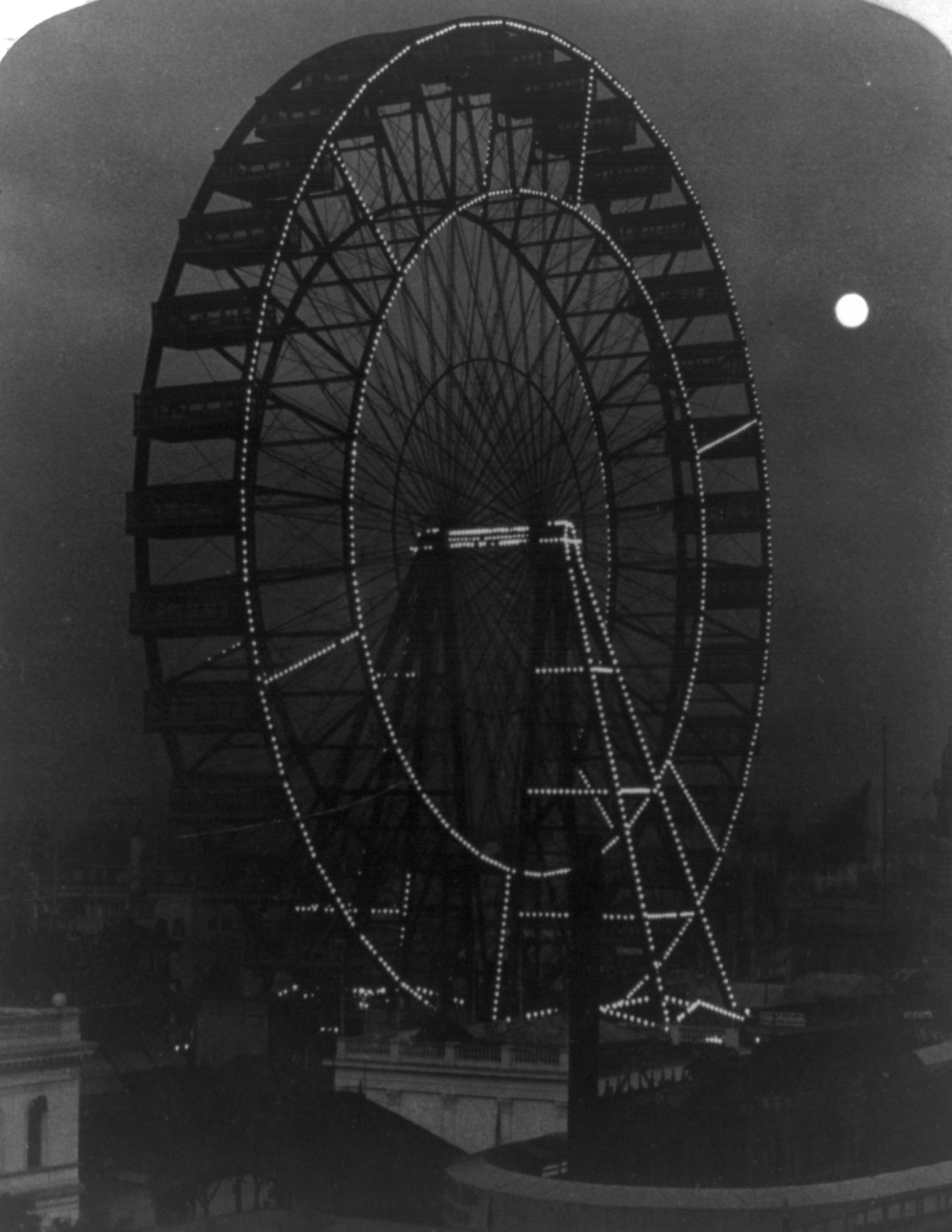
The fair
A season on the Midway.
The authorised history of the Exposition quotes the enabling act: dedication 12 October 1892, open by 1 May 1893, close not later than 30 October 1893.[1]The 1893 guidebook put general admission at fifty cents, described the Midway Plaisance as eighty acres connecting Jackson and Washington Parks, and advertised the Ferris Wheel at fifty cents for two revolutions, “carrying the passenger 250 feet in the air.”[2]
Fifty cents for two revolutions is independently in the 1893 guidebook and the 18 June Tribune. Rice has the 16 December concession letting the company keep the first $300,000 from tickets, then half the gross to the Exposition. The Tribune instead has half after receipts equalled “the cost of the wheel”. Weingardt treats $300,000 as a construction-cost cap and adds a sixty-day removal term not yet independently read.[2][3, pp. 80–81][3, p. 116][4, p. 476][5, p. 25]How the machine was built is on Building the Wheel. What it physically was is on The Original 1893 Ferris Wheel. This page is the season it ran.
June 1893
Preview, opening, and a patent suit.
Weingardt describes a 16 June press preview, with some 3,000 lights on the structure, quoting the Pittsburgh Commercial Gazette.[3, pp. 86–88]John P. Barrett, the fair’s electrician, recorded 1,540 lamps on the Wheel and 2,900 in all; the round “more than 3,000” is a contemporary press figure, not Barrett’s count.[3, pp. 86–88][14, pp. 19–21, 'Lighting of the Ferris Wheel']
The Wheel opened to the public on 21 June 1893. Opening-day papers agree that Hunt presided, Ferris spoke, and the Iowa State Band played from a car; they disagree on whether the start was at 3 or 4:30.[3, pp. 88–92][6, p. 2, 'The Triumph of Engineering'][7, p. 1, 'The Wheel Goes Round'][8, p. 5]
Weingardt records the Garden City company’s patent suit being served the day after the opening, with Ferris’s first deposition on 10 July. A matching National Archives file has been located and not read; the service date is not independently confirmed.[3, pp. 93–94][15][16]
The ride
Fifty cents, two revolutions, and a disputed clock.
Fifty cents for two revolutions is independently in the 1893 guidebook and the 18 June Tribune. How long that took is in conflict: Rice has twenty minutes for the double trip; the Tribune expected one revolution every twenty minutes; Searles, after the season, gives nine minutes a revolution.[2][3, p. 92][3, p. 95][4, p. 479][5, p. 25][9, p. 617][10, Item 8]There were thirty-six enclosed cars. Contemporary descriptions disagree on capacity: some give forty seats each, others sixty (forty seated plus standing), or 2,160–2,260 total.[3, p. 126][3, p. 92][4, pp. 475–480][10, Item 8][11, p. 8][12, pp. 274, 576–577][13]
9 July 1893
A storm, and two measurements.
The Wheel came through a severe storm on 9 July 1893. Syndicated reports said it did not move “a hair’s breadth”; a letter in Engineering News, via Weingardt, gave about an inch and a half of sideways movement.[3, pp. 93–94][17, p. 1, syndicated][18]
Crowds
Riders, receipts, and a family visit.
Rice gives 34,433 paid admissions on Chicago Day, 9 October 1893; Searles, writing in November 1893, gives 34,451 as the largest day. Weingardt’s about 10,000 riders a day, and 750,000 fair attendance that day, have not been independently read.[3, p. 72][3, p. 102][4, p. 479][9, pp. 618–619]Ferris said receipts passed $300,000 on 8 September 1893. Contemporary press put construction cost at $392,000; Weingardt, following the later lawsuit, gives $362,000.[3, p. 80][18][19, p. 2]
The stockholders’ figure, reported in November 1893, was 1,453,611 paid admissions. Gross-receipts figures in later accounts range from about $727,000 to “more than $750,000”.[3, pp. 94–95][3, p. 104][18][20][21]
Both the family record and Weingardt say his niece Eva Dangberg rode sixty-four times; Weingardt adds that a certificate signed by Ferris survives in the Dangberg family papers.[3, p. 96][22]The family record and Weingardt agree that his parents visited the fair and, on 5 September 1893, a reunion of some sixty Ferrises at Lake George near Galesburg.[3, p. 98][22]
November 1893
The fair closed. The Wheel did not, at first.
The fair closed on 30 October 1893, its ceremonies muted by the assassination of Mayor Harrison two days earlier (Weingardt, pp. 100–102).[3, pp. 100, 102]On 1 November 1893 Exposition guards tried to close the Wheel. A contemporary report quotes Ferris refusing to pay $75,000 and intending to run until 30 November; lawsuits followed both ways.[3, pp. 100–101][23, p. 2]
What became of the machine after that confrontation is the subject of What Happened to the Original Ferris Wheel.