The problem
Burnham’s challenge, and two dates.
Luther Rice’s 1901 account places Daniel H. Burnham’s challenge at an engineers’ luncheon early in 1891: American engineers had contributed nothing novel to the World’s Columbian Exposition, and Burnham wanted something to rival the Eiffel Tower — not a tower. The Carson City nomination gives 1892.[1, pp. 475–480][2, pp. 70–72]
Weingardt places Ferris’s Chicago office in the Rookery Building, where his inspection firm, alongside Robert W. Hunt’s, was testing steel for the fair’s buildings.[2, pp. 67–68, 70][2, p. 78]In his 1893 deposition, as quoted by Weingardt, Ferris said he had ridden a small wooden wheel at Atlantic City in September 1890 without knowing it was a Somers wheel.[2, p. 65][3][4]
The designer’s biography is on George Washington Gale Ferris Jr.. What the finished machine was — including the dimensional disagreements — is on The Original 1893 Ferris Wheel. This page is the construction sequence.
The idea
A dinner, or a chop-house lunch.
Luther Rice’s 1901 recollection has Ferris sketching the wheel at a dinner with friends; Ferris’s own 1893 interviews tell a chop-house version of the same idea.[1, pp. 475–480][2, p. 74]Ferris himself, in 1893 newspaper interviews, said he sketched the plan at a Chicago chop-house lunch. The two tellings may describe one evening or two; they are not collapsed into one fact.[2, p. 74][5, p. 2, 'The Great Ferris Wheel'][6, p. 2]
Calculations
Gronau’s numbers.
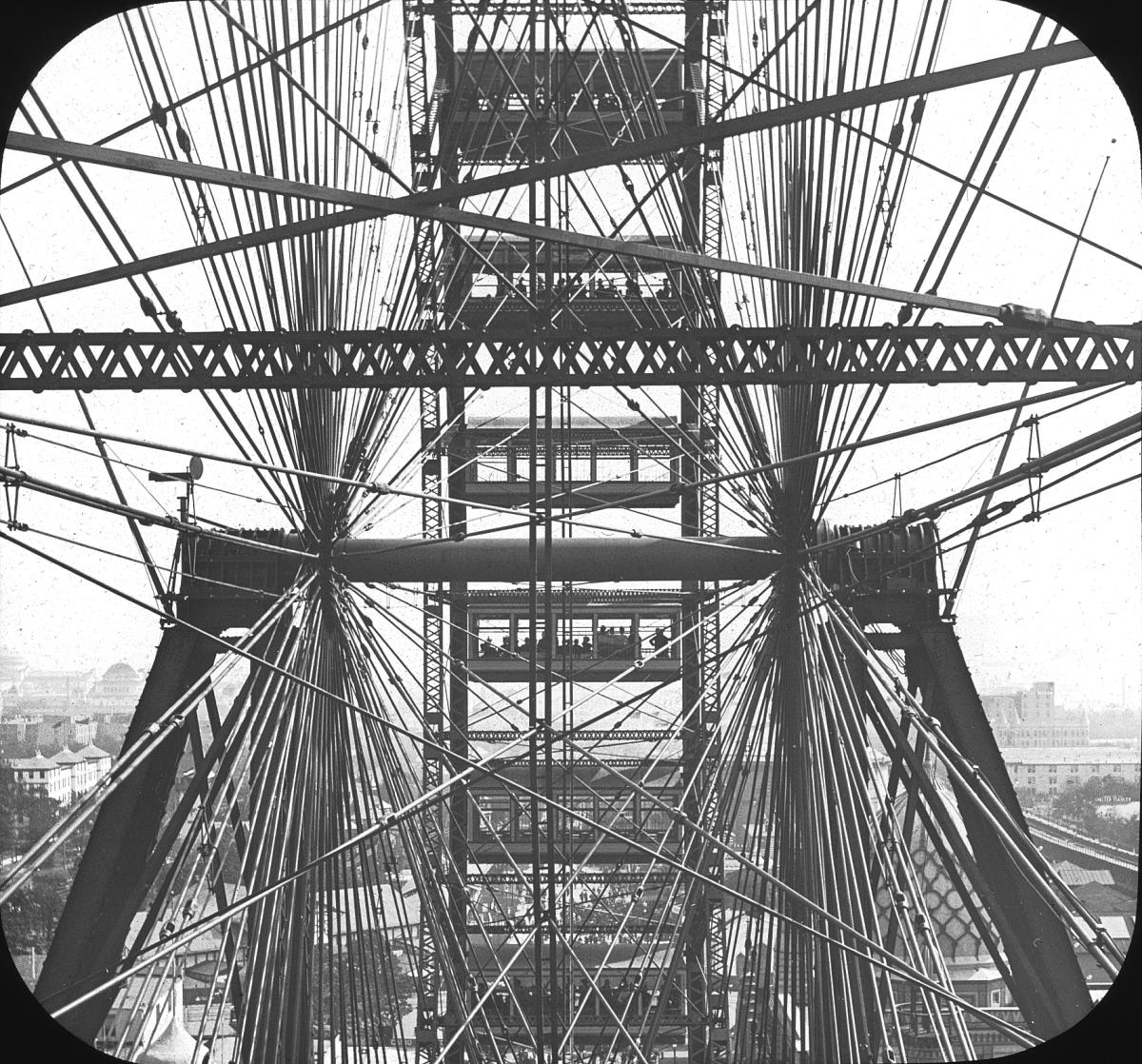
Rice’s 1901 account has William F. Gronau, a partner in Ferris’s firm, in charge of the detail drawings and strain sheets. Searles’s 1893 engineering paper, in discussion, cites Gronau for the Wheel’s weights and calculations. Gronau’s own 1893 paper has not been read independently; the encouragement anecdote remains Weingardt’s quotation of it.[1, pp. 475–476][2, pp. 74–75][7, pp. 619–621 (discussion)][8]The result was a steel tension wheel built like a bicycle wheel, with rods in tension rather than rigid spokes in compression. Rice gives the rods as 2-9/16 inches; Weingardt, and the 18 June Tribune, give 2½ inches.[1, p. 477][2, p. 74][2, p. 107][7, pp. 615–616][9, p. 25]
1892
Proposal, revocation, company, concession.
Rice’s 1901 account, matching the Chicago Tribune of 18 June 1893, has a concession granted in June 1892 and revoked the next day. Weingardt adds the committee’s reluctance and the “spider web” wind doubts.[1, p. 476][2, pp. 76–77][9, p. 25]Weingardt names Robert W. Hunt, Julian Kennedy, Andrew Onderdonk and Judge William Vincent among the backers Ferris brought to his second application. Rice independently has Hunt as president and Vincent as secretary at the opening; Kennedy and Onderdonk as second-application backers remain Weingardt’s account.[1, p. 478][2, pp. 77–78]
The Chicago Tribune of 18 June 1893 reported the Ferris Wheel Company capitalised at $600,000. Rice names Hunt as president and Vincent as secretary at the opening. Following Anderson, Weingardt dates incorporation to 9 June 1892 and a Pittsburgh Construction Company to 14 November; those filing dates have not been independently read.[1, p. 478][2, p. 78][9, p. 25]
Rice and Ferris’s own 1893 account date the board’s concession to 16 December 1892, less than four months before the fair opened; Weingardt dates a formal agreement to 29 November.[1, pp. 475–480][2, pp. 79–81][5, p. 2]Fifty cents for two revolutions is independently in the 1893 guidebook and the 18 June Tribune. Rice has the 16 December concession letting the company keep the first $300,000 from tickets, then half the gross to the Exposition. The Tribune instead has half after receipts equalled “the cost of the wheel”. Weingardt treats $300,000 as a construction-cost cap and adds a sixty-day removal term not yet independently read.[1, p. 476][2, pp. 80–81][2, p. 116][9, p. 25][10]
Rice’s 1901 account, and Ferris’s 12 December 1892 letter as quoted by Weingardt, record Rice’s hiring as construction superintendent; he stayed with the Wheel until 1903.[1, pp. 475–480][2, p. 81]
Winter 1892–93
A Detroit contract, and frozen ground.
On 22 December 1892 the Associated Press, from Detroit, announced the Detroit Bridge and Iron Works as contractor to construct the Wheel for $300,000.[11, p. 5 (Associated Press, Detroit)][12, p. 3]A contemporary Chicago technical feature dated the start of work to 8 January 1893.[1, pp. 475–480][2, p. 83][13, p. 5]
Rice’s 1901 account, matching a Chicago Citizen feature of 12 August 1893, describes thawing frozen quicksand with live steam to sink the foundations from January 1893.[1, pp. 475–480][2, p. 83][13, p. 5]
Shops
Not one shop, and not only Detroit.
Rice describes fabrication spread across a dozen shops, with Ferris’s inspectors on the work; Engineering News recorded 2,200 tons put in shape at Detroit. Weingardt adds the March 1893 shipment of 150 railroad cars to Chicago.[1, pp. 475–480][2, pp. 82–83][14]The Carson City nomination’s shorthand — that the Wheel was built in Pittsburgh and reassembled in Chicago — is a later compression of that dispersed fabrication, not a second construction history.
The axle was a forged-steel shaft about 45 feet long, reported at shipment as 33 inches in diameter and 89,320 pounds (Weingardt gives 32 inches and about 45 tons), described then as the largest piece of steel yet forged in the country.[1, p. 477][2, p. 74][2, p. 83][7, p. 616][15, p. 2][16, p. 576]Rice dates the first tower post to 20 March 1893; the 18 June Tribune dates the start of scaffolding to the same day. Weingardt has the first tower completed on 20 March and the structure, minus cars, complete about 1 June — that completion date has not been independently read.[1, p. 477][2, p. 84][9, p. 25]
Drive and light
Steam at a distance, lamps on the rims.
Driven by steam engines with a Westinghouse air brake, through endless chains at the rims; Barrett, the fair’s electrician, placed the boiler and dynamo plant 700 feet outside the grounds. Weingardt gives the engines as two 1,000-horsepower units, one in reserve.[2, p. 83][2, p. 107][17, pp. 19–21]Barrett recorded 1,540 lamps on the Wheel and 2,900 in all; press accounts of the 16 June preview round that to “more than 3,000.”[2, pp. 86–88][17, pp. 19–21, 'Lighting of the Ferris Wheel']
June 1893
Testing, preview, opening.
The first revolution came at six o’clock on the evening of 9 June 1893, as Rice telegraphed Ferris and Ferris confirmed the next day.[2, p. 85][18]Rice’s 1901 account has a six-car trial on 11 June 1893, with Margaret Ferris on the first passenger trip. Searles’s 1893 discussion independently has six cars for the first passengers. The chair-cheer at the top remains Weingardt’s quotation of unread Gronau 1893.[1, p. 478][2, pp. 85–86][7, p. 620 (discussion)][8]
Weingardt describes a 16 June press preview, with some 3,000 lights on the structure, quoting the Pittsburgh Commercial Gazette.[2, pp. 86–88]The Wheel opened to the public on 21 June 1893. Opening-day papers agree that Hunt presided, Ferris spoke, and the Iowa State Band played from a car; they disagree on whether the start was at 3 or 4:30.[2, pp. 88–92][19, p. 2, 'The Triumph of Engineering'][20, p. 1, 'The Wheel Goes Round'][21, p. 5]
The Wheel came through a severe storm on 9 July 1893. Syndicated reports said it did not move “a hair’s breadth”; a letter in Engineering News, via Weingardt, gave about an inch and a half of sideways movement.[2, pp. 93–94][14][22, p. 1, syndicated]
Afterward
How fast, according to whom.
Weingardt quotes a January 1897 War Department letter asking Rice how the Wheel had been built so fast.[2, p. 115]That later inquiry is evidence of the impression the schedule made; it is not itself a construction diary. The sequence above prefers Rice’s 1901 account, Ferris’s 1893 interviews, the Detroit contract wire, Engineering News, Barrett, and the surviving telegrams over any single later retelling.