Ferris Wheel Accreditation
Program in formation · No accreditations are currently issued
A designation this project hopes to earn the right to offer.
A future voluntary accreditation program intended to recognize Ferris Wheel installations that meet transparent standards for heritage, engineering, education, and public trust.
Why accreditation
The wheel does not need permission. Recognition should still mean something.
Colleges may operate without institutional accreditation; accreditation gives students and the public a way to understand which institutions have voluntarily met a published standard. The same distinction guides this early Ferris Wheel concept.
The goal is not to control every use of a common name. It is to build a respected designation that operators and manufacturers would choose because it adds historical credibility, technical discipline, and educational value.
Working framework
What the designation should stand for.
The distinction
Accreditation would recognize a standard—not grant permission to exist.
A Ferris wheel can be designed, built, and operated without this future program. The ambition is to create a voluntary, independent review through which an installation could demonstrate that it meets published expectations and responsibly carries the Ferris Wheel name.
The standard
Heritage, engineering, education, and public trust belong in one framework.
The future criteria could bring together accurate historical attribution, qualified technical review, safety and accessibility practices, long-term maintenance, and public education about the machine and the engineer whose name became its identity.
The process
Evidence first. Independent review. Renewal over time.
A credible pathway would require an application, documented evidence, review by qualified and conflict-aware experts, a clear decision, a public register, periodic renewal, and meaningful correction or appeal procedures. Those details have not yet been adopted.
The return
Recognition could help the name fund its own future.
If the program is lawfully established, modest accreditation fees and aligned partnerships could help sustain the historical archive, educational work, and future engineering scholarships. No fees are currently set or accepted.
Concept identity
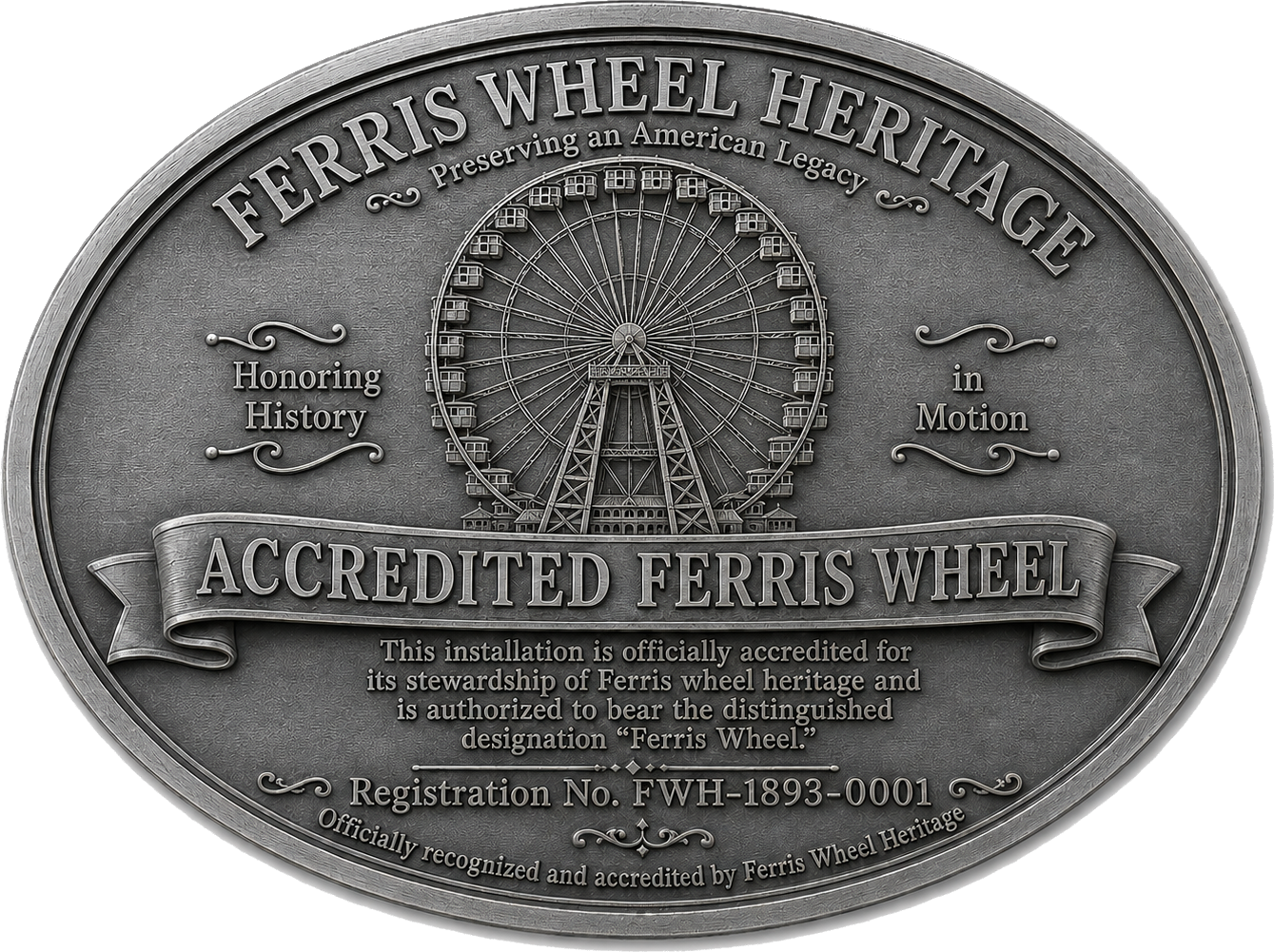
A symbol for a program still being built.
This early seal explores how an accredited installation might one day be recognized. It is concept artwork only: it does not identify an accredited wheel, registration, legal authority, or currently available credential.
Before the first designation
The institution must be as credible as the mark.
The public standard, legal structure, review authority, and accountability model all come before any accreditation.
- 01
Establish the governing legal entity and its relationship to the Ferris family stewardship council.
- 02
Complete trademark and accreditation-mark review with qualified counsel.
- 03
Develop public standards with manufacturers, operators, engineers, historians, accessibility experts, and educators.
- 04
Create independent review, conflict-of-interest, renewal, correction, and appeal procedures.
- 05
Pilot the framework before any installation is represented as accredited.
Build the standard with us
Accreditation only earns trust when the right people shape it.
Manufacturers, operators, engineers, historians, accessibility experts, educators, museums, and industry associations are invited into an exploratory conversation—not a licensing or accreditation offer.
Explore prospective partnerships