The short version
One machine, three sites, thirteen years.
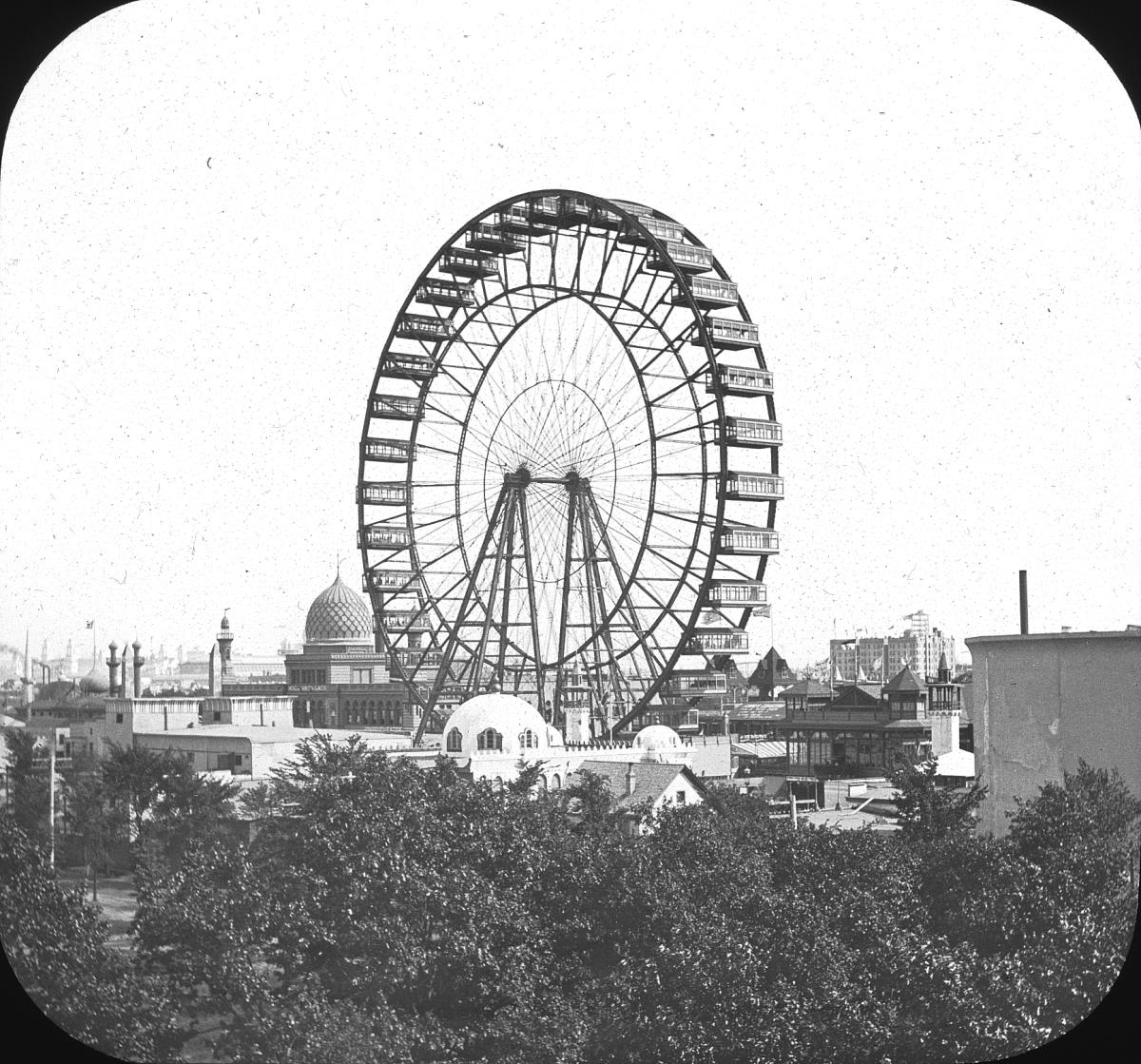
The first Ferris Wheel was a steel observation wheel designed by George Washington Gale Ferris Jr. for Chicago’s World’s Columbian Exposition. It opened to the public on 21 June 1893, and its stockholders reported 1,453,611 paid admissions that season.[2, pp. 88–92][2, pp. 94–95][2, p. 104][9, p. 2, 'The Triumph of Engineering'][10, p. 1, 'The Wheel Goes Round'][11, p. 5][12][13][14]It stood again on Chicago’s North Clark Street in 1895–96, was sold for salvage in 1903, ran one more season at the St. Louis world’s fair of 1904, and was dynamited on 11 May 1906.[2, pp. 108–111][2, pp. 118–119][2, p. 120][16][21, Item 8][24, pp. 1, 4–9][25, pp. 2–7][26, p. 8 (Chicago Tribune dispatch of 12 May)]No part of it is known to survive, and the fate of its great axle is one of the record’s open questions.[2, p. 120][24, pp. 4–9][25, pp. 2–7][26, p. 8][27]
Each stage below has a canonical page on this site that treats it in full, with its sources and its disagreements; this page is the arc. If you want the numbers rather than the story, that is Engineering the 1893 Wheel. If you want the dates without the prose, that is the Timeline. If your question is who actually invented the thing, start at Who Invented the Ferris Wheel?
1891–1892
A challenge, a sketch, and a revoked concession.
Luther Rice’s 1901 account places Daniel H. Burnham’s challenge at an engineers’ luncheon early in 1891: American engineers had contributed nothing novel to the coming exposition, and Burnham wanted something to rival the Eiffel Tower — not a tower. Rice is the source of the “out-Eiffel Eiffel” phrase. The Carson City nomination gives 1892. Both dates stay on the record.[1, pp. 475–480][2, pp. 70–72]Ferris answered with a revolving steel wheel, and Rice’s 1901 account, matching the Chicago Tribune of 18 June 1893, has a concession granted in June 1892 and revoked the next day.[1, p. 476][2, pp. 76–77][3, p. 25]
The Chicago Tribune of 18 June 1893 reported the Ferris Wheel Company capitalised at $600,000; Weingardt, following Anderson, dates incorporation to 9 June 1892, and those filing dates have not been independently read.[1, p. 478][2, p. 78][3, p. 25]Rice and Ferris’s own 1893 account date the board’s concession to 16 December 1892 — less than four months before the fair opened; Weingardt dates a formal agreement to 29 November.[1, pp. 475–480][2, pp. 79–81][4, p. 2]The full sequence, including the backers Ferris assembled and the terms’ disputed profit-sharing, is on Building the Wheel.
1893
Frozen ground, a Detroit contract, and June.
On 22 December 1892 the Associated Press, from Detroit, announced the Detroit Bridge and Iron Works as contractor to construct the Wheel for $300,000.[5, p. 5 (Associated Press, Detroit)][6, p. 3]The Chicago Citizen of 12 August 1893 dates the start of foundation work to 8 January 1893 and describes thawing quicksand with live steam, matching Rice’s later account.[1, pp. 475–480][2, p. 83][7, p. 5]The first revolution came at six o’clock on the evening of 9 June 1893, and the Wheel opened to the public on 21 June — opening-day papers agree on the ceremony and disagree on whether it began at 3 or 4:30.[2, p. 85][2, pp. 88–92][8][9, p. 2, 'The Triumph of Engineering'][10, p. 1, 'The Wheel Goes Round'][11, p. 5]
The season that followed — the fifty-cent ride, the July storm, the crowds, the receipts, and the patent suit served the day after the opening — is on The Wheel at the World’s Columbian Exposition. Its two headline dates: the stockholders reported 1,453,611 paid admissions in November 1893, and the fair itself closed on 30 October, its ceremonies muted by Mayor Harrison’s assassination two days earlier.[2, pp. 94–95][2, p. 104][2, pp. 100, 102][12][13][14]
1893–1897
Shutdown, suits, Clark Street, and ruin.
On 1 November 1893 Exposition guards tried to close the Wheel. A contemporary report quotes Ferris refusing to pay $75,000 and intending to run until 30 November; lawsuits followed both ways.[2, pp. 100–101][15, p. 2]Weingardt records the Wheel dismantled in spring 1894 for $14,833 and stored on rail cars.[2, p. 106]
Weingardt traces the Wheel’s re-erection at North Clark Street in 1895–96 and the neighbourhood opposition; the Illinois courts’ own history records the 1896 Supreme Court ruling that kept the park from selling liquor.[2, pp. 108–111][16]Ferris died of typhoid fever at Mercy Hospital, Pittsburgh, on 22 November 1896, aged 37; the family record gives 28 November, and every other source read gives the 22nd.[2, pp. 111–112][17, pp. 32–34][18, p. 1][19, p. 3 (dateline Pittsburg, 22 Nov.)][20, p. 6][21, Item 8][22][23]Weingardt records the company bankrupt by November 1896, and two months after Ferris’s death the court gave the Exposition an $84,000 judgment against it.[2, pp. 111, 118][2, p. 116][14]
One lawsuit from these years is still unresolved on this site. Weingardt has the Garden City patent suit dismissed on 3 July 1894 with $26.50 costs to Ferris, and states that Ferris never patented the Wheel; a 23 November 1893 New Jersey paper reported that the highest court had found infringement and royalties due. The case file has been located and not read, so the outcome stays in dispute.[2, p. 107][2, p. 96][35, p. 3][36][37]The complete afterlife is on What Happened to the Original Ferris Wheel.
1903–1906
St. Louis, and 200 pounds of dynamite.
Sold to the Chicago House Wrecking Company in 1903, the Wheel was moved by rail to St. Louis for the 1904 fair. Harris’s later study gives 175 freight cars; a St. Louis library article gives 178.[2, pp. 118–119][21, Item 8][24, pp. 1, 4–9][25, pp. 2–7]The 1903 salvage sale is reported as $1,800 in a Chicago Tribune item of 3 June and as $8,150 in later St. Louis summaries of 7 June; both figures stay on the page until the original notices are compared.[2, pp. 118–119][14][25, pp. 2–7]
It ran again at the 1904 St. Louis fair. Company-family papers later published by Leo Harris give $267,000 gross; Weingardt had $215,000 and “over a million” riders.[2, pp. 118–119][24, pp. 1, 4–9][25, pp. 2–7]A St. Louis County Library summary, following local papers, dates the last revolution to 13 January 1906, with three people aboard.[2, p. 120][25, pp. 2–7]The Wheel was dynamited on 11 May 1906 — 200 pounds in two stages, according to the Chicago Tribune dispatch — and scrapped.[2, p. 120][21, Item 8][26, p. 8 (Chicago Tribune dispatch of 12 May)]
The axle’s fate is unresolved. One line of evidence, from Chicago House Wrecking Company records, says it was cut up in Chicago around 1919; St. Louis searches in 1943 and 2007 looked for a buried shaft and did not excavate.[2, p. 120][24, pp. 4–9][25, pp. 2–7][26, p. 8][27]The sale, the move, the 1904 season, the demolition and that open question are treated in full on What Happened to the Original Ferris Wheel.
After 1906
How the name became a type of machine.
The original was gone, but the type was already international. Weingardt traces the first imitations: Basset’s great wheels in London, Blackpool, Vienna and Paris, and Sullivan’s portable wheels from Jacksonville, Illinois.[2, pp. 96, 105, 109–110, 121]They were built without payment to Ferris, who never patented the Wheel.[2, p. 107][2, p. 96][35, p. 3][36][37]Those later wheels are not the 1893 machine, and this site claims no relationship to any wheel, manufacturer or attraction operating today. The question of what Ferris did and did not invent is treated at length on Who Invented the Ferris Wheel?
The record
What the sources still argue about.
| Question | What the sources say |
|---|---|
| How tall was it? | 250 feet in diameter and about 264 feet to the top — Engineering News said so in July 1893. Sources that say “250 feet tall” are usually quoting the diameter; a few contemporary pieces say 265.[2, p. 74][2, p. 86][2, p. 84][7, p. 5][13][28, p. 8][29] |
| How big was the axle? | A forged-steel axle about 45 feet long, reported at shipment as 33 inches in diameter and 89,320 pounds; Weingardt gives 32 inches and about 45 tons.[1, p. 477][2, p. 74][2, p. 83][30, p. 2][31, p. 576][32, p. 616] |
| How many people could ride? | Thirty-six enclosed cars. Contemporary descriptions disagree on capacity: some give forty seats each, others sixty (forty seated plus standing), or 2,160–2,260 in all.[1, pp. 475–480][2, p. 126][2, p. 92][21, Item 8][28, p. 8][29][31, pp. 274, 576–577] |
| What did it cost to build? | Contemporary press and Engineering News give $392,000; Weingardt, following the later lawsuit, gives $362,000; the Carson City nomination gives $390,000. The concession recognised $300,000 before profit-sharing.[2, p. 80][2, p. 116][4, p. 2][13] |
| How long was a ride? | Fifty cents for two revolutions is independently sourced; the clock is not. Rice has twenty minutes for the double trip; the Tribune expected one revolution every twenty minutes; Searles, after the season, gives nine minutes a revolution.[1, p. 479][2, p. 92][2, p. 95][3, p. 25][21, Item 8][32, p. 617][34] |
| How many lights? | Barrett, the fair’s electrician, recorded 1,540 lamps on the Wheel and 2,900 in all; press accounts of the 16 June preview round that to “more than 3,000.”[2, pp. 86–88][33, pp. 19–21, 'Lighting of the Ferris Wheel'] |
| What were the concession terms? | Rice has the company keeping the first $300,000 from tickets, then half the gross to the Exposition; the Tribune has half after receipts equalled “the cost of the wheel”; Weingardt treats $300,000 as a construction-cost cap.[1, p. 476][2, pp. 80–81][2, p. 116][3, p. 25][34] |
| How busy was Chicago Day? | Rice gives 34,433 paid admissions on 9 October 1893; Searles, writing in November 1893, gives 34,451 as the largest day.[1, p. 479][2, p. 72][2, p. 102][32, pp. 618–619] |
| What was it sold for in 1903? | $1,800 in a Chicago Tribune item of 3 June; $8,150 in later St. Louis summaries of 7 June.[2, pp. 118–119][14][25, pp. 2–7] |
| How did it get to St. Louis, and what did it earn? | 175 freight cars in Harris’s study, 178 in a St. Louis library article. Gross receipts $267,000 in the company-family papers, about $215,000 in Weingardt.[2, pp. 118–119][21, Item 8][24, pp. 1, 4–9][25, pp. 2–7] |
| Where is the axle? | Unresolved: cut up in Chicago around 1919 per one line of evidence from company records, or buried near where the Wheel stood per St. Louis searches in 1943 and 2007 that did not excavate.[2, p. 120][24, pp. 4–9][25, pp. 2–7][26, p. 8][27] |
The full treatment of each row is on The Original 1893 Ferris Wheel and Engineering the 1893 Wheel. Why this site keeps conflicts visible instead of resolving them by preference is on Research method.
FAQ
Why it was built.
Was the Ferris Wheel meant to out-Eiffel the Eiffel Tower?
Yes, as a rival attraction, not as a copy of a tower. Luther Rice’s 1901 account places Daniel H. Burnham’s challenge at an engineers’ luncheon early in 1891: American engineers had contributed nothing novel, and Burnham wanted something to rival the Eiffel Tower — not a tower. Rice is the source of the “out-Eiffel Eiffel” phrase. The Carson City nomination dates the same challenge to 1892. Both dates stay on the record.[1, pp. 475–480][2, pp. 70–72]
The construction sequence that followed that challenge is on Building the Wheel.