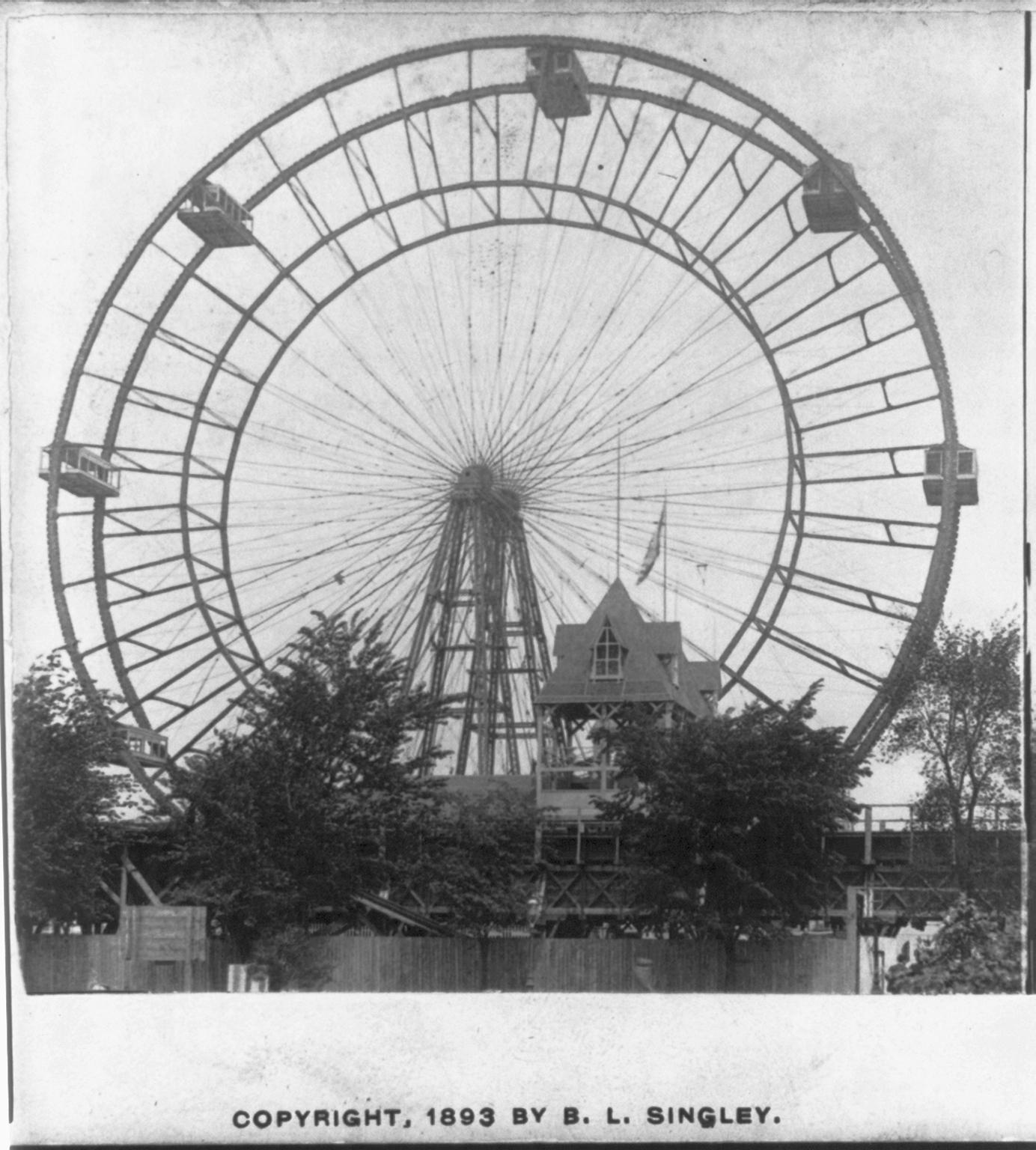
The machine
What the original Ferris Wheel was.
It was a steel observation wheel built for the World’s Columbian Exposition on Chicago’s Midway Plaisance, designed by George Washington Gale Ferris Jr. and opened to the public on 21 June 1893.[4, pp. 88–92][17, p. 2, 'The Triumph of Engineering'][18, p. 1, 'The Wheel Goes Round'][19, p. 5]Later amusement wheels borrowed the name. This page is about the 1893 machine: its size, structure, cars, power, lighting, cost, and the short afterlife that followed the fair.
The designer’s life is treated on George Washington Gale Ferris Jr.. How the Wheel went from a rejected proposal to an operating structure is treated on Building the Wheel. This page answers a different question: what, exactly, was it?
Size
Diameter, height, and a 250-foot habit.
Engineering News, in July 1893, described a 250-foot wheel extending about 264 feet above the ground. Sources that say “250 feet tall” are usually quoting the diameter; a few contemporary pieces say 265.[1, p. 8][2][3, p. 5][4, p. 74][4, p. 86][4, p. 84][5]
J. J. Flinn’s Exposition guidebook advertised the Wheel at fifty cents for two revolutions, “carrying the passenger 250 feet in the air” — again the diameter used as a height of ride.[14]
Structure
A bicycle wheel in steel.
It was a steel tension wheel built like a bicycle wheel, with rods in tension rather than rigid spokes in compression. Rice gives the rods as 2-9/16 inches; Weingardt, and the 18 June Tribune, give 2½ inches.[4, p. 74][4, p. 107][6, p. 477][7, p. 25][8, pp. 615–616]The axle was a forged-steel shaft about 45 feet long, reported at shipment as 33 inches in diameter and 89,320 pounds (Weingardt gives 32 inches and about 45 tons), described then as the largest piece of steel yet forged in the country.[4, p. 74][4, p. 83][6, p. 477][8, p. 616][9, p. 2][10, p. 576]
That “largest yet forged” line is how the New-York Tribune and Bethlehem’s own exhibit described the shipment in March 1893. It is reported here as a contemporary claim, not as a comparison this site has independently checked against other forgings.
Cars and power
Thirty-six cars, steam, and light.
There were thirty-six enclosed cars. Contemporary descriptions disagree on capacity: some give forty seats each, others sixty (forty seated plus standing), or 2,160–2,260 in all.[1, p. 8][4, p. 126][4, p. 92][5][6, pp. 475–480][10, pp. 274, 576–577][11, Item 8]
It was driven by steam engines with a Westinghouse air brake, through endless chains at the rims. John P. Barrett, the fair’s electrician, placed the boiler and dynamo plant 700 feet outside the grounds. Weingardt gives the engines as two 1,000-horsepower units, one in reserve.[4, p. 83][4, p. 107][12, pp. 19–21]
Barrett recorded 1,540 lamps on the Wheel and 2,900 in all; press accounts of the 16 June preview round that to “more than 3,000.”[4, pp. 86–88][12, pp. 19–21, 'Lighting of the Ferris Wheel']
Fifty cents for two revolutions is independently in the 1893 guidebook and the 18 June Tribune. Rice has the 16 December concession letting the company keep the first $300,000 from tickets, then half the gross to the Exposition. The Tribune instead has half after receipts equalled “the cost of the wheel”. Weingardt treats $300,000 as a construction-cost cap. How long a ride took is in conflict: Rice has twenty minutes for the double trip; the Tribune expected one revolution every twenty minutes; Searles, after the season, gives nine minutes a revolution.[4, pp. 80–81][4, p. 116][4, p. 92][4, p. 95][6, p. 476][6, p. 479][7, p. 25][8, p. 617][11, Item 8][14]
The record
What the sources actually give.
| Subject | What survives in the sources |
|---|---|
| Diameter / height | 250 ft diameter; about 264 ft to the top in Engineering News. Some contemporary pieces give 265 ft. “250 feet tall” usually restates the diameter.[1, p. 8][2][3, p. 5][4, p. 74][4, p. 86][4, p. 84][5] |
| Axle | About 45 ft long. Tribune shipment: 33 in, 89,320 lb. Weingardt: 32 in, about 45 tons.[4, p. 74][4, p. 83][6, p. 477][8, p. 616][9, p. 2][10, p. 576] |
| Cars | Thirty-six enclosed cars. Seated capacity of 40 in some 1893 descriptions; 60 per car (or 2,160–2,260 total) in others.[1, p. 8][4, p. 126][4, p. 92][5][6, pp. 475–480][10, pp. 274, 576–577][11, Item 8] |
| Lighting | Barrett: 1,540 lamps on the Wheel, 2,900 in all. Press preview: “more than 3,000.”[4, pp. 86–88][12, pp. 19–21, 'Lighting of the Ferris Wheel'] |
| Construction cost | Contemporary press and Engineering News: $392,000. Weingardt, following the later lawsuit: $362,000. Carson City nomination: $390,000. The concession recognised $300,000 before profit-sharing.[2][4, p. 80][4, p. 116][13, p. 2] |
| Paid admissions, 1893 | 1,453,611, the stockholders’ figure of November 1893. Gross-receipts figures later range from about $727,000 to “more than $750,000.”[2][4, pp. 94–95][4, p. 104][20][21] |
At the fair
Opening, ridership, receipts.
The authorised history of the Exposition quotes the enabling act: dedication 12 October 1892, open by 1 May 1893, close not later than 30 October 1893.[15]The first revolution came at six o’clock on the evening of 9 June 1893, as Rice telegraphed Ferris.[4, p. 85][16]
Rice gives 34,433 paid admissions on Chicago Day, 9 October 1893; Searles, writing in November 1893, gives 34,451 as the largest day. Weingardt’s about 10,000 riders a day, and 750,000 fair attendance that day, have not been independently read.[4, p. 72][4, p. 102][6, p. 479][8, pp. 618–619]Ferris said receipts passed $300,000 on 8 September 1893. Contemporary press put construction cost at $392,000; Weingardt, following the later lawsuit, gives $362,000.[2][4, p. 80][13, p. 2]
Why it mattered
A name, and a type of machine.
In his 1893 deposition, as quoted by Weingardt, Ferris said he had ridden a small wooden wheel at Atlantic City in September 1890 without knowing it was a Somers wheel.[4, p. 65][22][23]William Somers’s U.S. Patent 489,238, issued 3 January 1893, describes a wooden-rim roundabout with radial spokes, swinging seats, and a cable drive — the patent later asserted against Ferris.[4, pp. 93–94, 107][24][25]
What Ferris built was not that wooden roundabout. It was a steel tension wheel on the scale of a bridge, paid for as a concession, and copied, without payment to him, as a new class of amusement structure. Weingardt traces the first imitations: Basset’s great wheels in London, Blackpool, Vienna and Paris, and Sullivan’s portable wheels from Jacksonville, Illinois.[4, pp. 96, 105, 109–110, 121]
After Chicago
A short bridge to the afterlife.
The dedicated account of Clark Street, the 1904 St. Louis fair, and demolition is What Happened to the Original Ferris Wheel. The facts that belong here, briefly, are these.
Weingardt traces the Wheel’s re-erection at North Clark Street in 1895–96.[4, pp. 108–111][26]Sold to the Chicago House Wrecking Company in 1903, it was moved by rail to St. Louis for the 1904 fair. Harris’s later study gives 175 freight cars; a St. Louis library article gives 178. The 1903 salvage sale is reported as $1,800 in a Chicago Tribune item of 3 June and as $8,150 in later St. Louis summaries of 7 June.[4, pp. 118–119][11, Item 8][21][27, pp. 1, 4–9][28, pp. 2–7]
A St. Louis County Library summary dates the last revolution to 13 January 1906, with three people aboard. The Wheel was dynamited on 11 May 1906 — 200 pounds in two stages, according to the Chicago Tribune dispatch — and scrapped. The axle’s fate is unresolved. One line of evidence, from Chicago House Wrecking Company records, says it was cut up in Chicago around 1919; St. Louis searches in 1943 and 2007 looked for a buried shaft and did not excavate.[4, p. 120][11, Item 8][27, pp. 4–9][28, pp. 2–7][29, p. 8 (Chicago Tribune dispatch of 12 May)][29, p. 8][30]