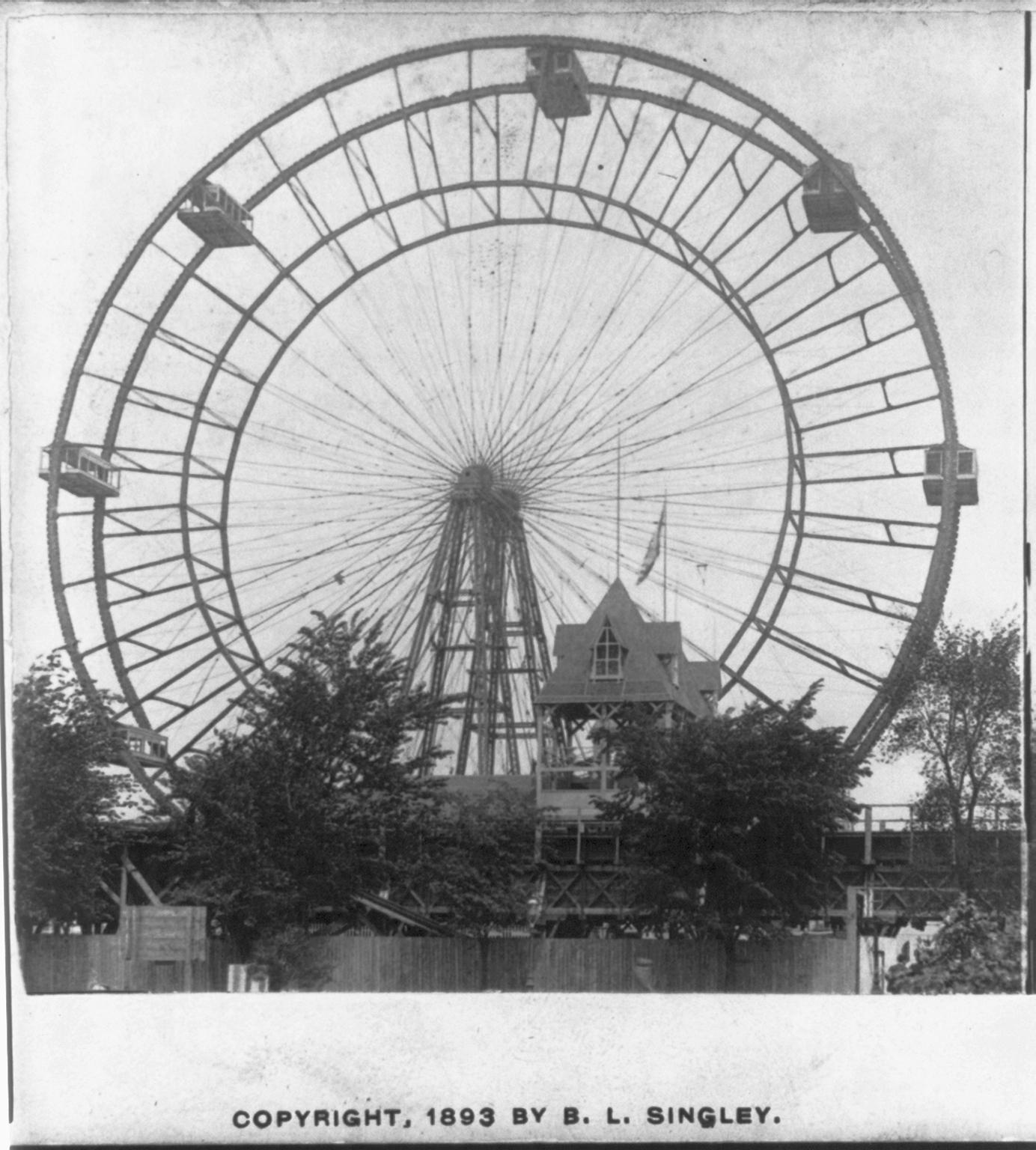
November 1893
A shutdown, then a suit.
On 1 November 1893 Exposition guards tried to close the Wheel. A contemporary report quotes Ferris refusing to pay $75,000 and intending to run until 30 November; lawsuits followed both ways.[1, p. 2][2, pp. 100–101]A contemporary report quotes Ferris refusing a $75,000 Exposition demand in early November 1893. Weingardt dates the Exposition’s suit for that sum to 9 November. The filing date has not been independently read in a court record.[1, p. 2][2, p. 104][2, p. 116]
Weingardt estimates the Exposition took about $225,000 clear from the Wheel and the company perhaps $150,000 to $163,000 before its own costs.[2, pp. 102, 104]Those are later estimates, not the stockholders’ 1,453,611 paid-admissions figure from the fair season.
1894
Idle on the Midway, then taken apart.
Weingardt records the Wheel dismantled in spring 1894 for $14,833 and stored on rail cars.[2, p. 106]Weingardt has the Garden City patent suit dismissed on 3 July 1894 with $26.50 costs to Ferris, and states that Ferris never patented the Wheel. A 23 November 1893 New Jersey paper reported that the highest court had found infringement and royalties due. The case file has been located and not read; the outcome stays in dispute.[2, p. 107][2, p. 96][3, p. 3][4][5]
William Somers’s U.S. Patent 489,238, filed 28 October 1891 and issued 3 January 1893, describes a wooden-rim roundabout with radial spokes, swinging seats, and a cable drive — the patent later asserted against Ferris.[2, pp. 93–94, 107][6][7]The case file itself has not been read here in full; the public wording stays with what Weingardt and the issued patent establish.
1895–1896
North Clark Street.
Weingardt traces the Wheel’s re-erection at North Clark Street in 1895–96 and the neighbourhood opposition; the Illinois courts’ own history records the 1896 Supreme Court case.[2, pp. 108–111][8]The Illinois courts’ own history records that the Supreme Court denied the Ferris Wheel Company a dram-shop permit for the Clark Street park in 1896; the exact reporter citation is still being checked.[2, pp. 108–111][8]
Weingardt records the company bankrupt by November 1896; the Hyde Park Historical Society reprints the Tribune’s 1903 note of an $1,800 receiver’s sale.[2, pp. 111, 118][9]Two months after Ferris’s death, Weingardt records, the court gave the Exposition an $84,000 judgment against the company.[2, p. 116]
1903–1904
Sold, shipped, and run again.
Sold to the Chicago House Wrecking Company in 1903, the Wheel was moved by rail to St. Louis for the 1904 fair. Harris’s later study gives 175 freight cars; a St. Louis library article gives 178.[2, pp. 118–119][10, pp. 1, 4–9][11, pp. 2–7][12, Item 8]The 1903 salvage sale is reported as $1,800 in a Chicago Tribune item of 3 June and as $8,150 in later St. Louis summaries of 7 June; both figures stay on the page until the original notices are compared.[2, pp. 118–119][9][11, pp. 2–7]
The Wheel ran at the 1904 St. Louis fair. Company-family papers later published by Leo Harris give 175 freight cars and $267,000 gross; Weingardt had $215,000 and “over a million” riders. A St. Louis library summary says 178 cars.[2, pp. 118–119][10, pp. 1, 4–9][11, pp. 2–7]
1906
Last revolution, dynamite, and an axle that still disagrees.
A St. Louis County Library summary, following local papers, dates the last revolution to 13 January 1906, with three people aboard.[2, p. 120][11, pp. 2–7]The Wheel was dynamited on 11 May 1906 — 200 pounds in two stages, according to the Chicago Tribune dispatch — and scrapped; what became of the great axle is unresolved.[2, p. 120][12, Item 8][13, p. 8 (Chicago Tribune dispatch of 12 May)]
The axle’s fate is unresolved. One line of evidence, from Chicago House Wrecking Company records, says it was cut up in Chicago around 1919; St. Louis searches in 1943 and 2007 looked for a buried shaft and did not excavate.[2, p. 120][10, pp. 4–9][11, pp. 2–7][13, p. 8][14]
Weingardt traces the first imitations: Basset’s great wheels in London, Blackpool, Vienna and Paris, and Sullivan’s portable wheels from Jacksonville, Illinois.[2, pp. 96, 105, 109–110, 121]Those later wheels are not this machine. The original is the 1893 tension wheel whose parts were sold for scrap in 1906.