How to use this page
A table, not a winner.
The narrative of how the Wheel was conceived and raised is on Building the Wheel. The machine as a public subject is on The Original 1893 Ferris Wheel. This page collects the structural figures so they do not drift between those accounts.
Calculations
Gronau’s numbers.
Rice’s 1901 account has William F. Gronau, a partner in Ferris’s firm, in charge of the detail drawings and strain sheets. Searles’s 1893 engineering paper, in discussion, cites Gronau for the Wheel’s weights and calculations. Gronau’s own 1893 paper has not been read independently; the encouragement anecdote remains Weingardt’s quotation of it.[1, pp. 74–75][2, pp. 475–476][3, pp. 619–621 (discussion)][4]Gronau’s 1893 paper has not been read independently here. The public wording does not treat Weingardt’s quotations as equivalent to opening Gronau himself.
The structure
What the sources give.
| Diameter and height | 250 feet in diameter and about 264 feet to the top — Engineering News said so in July 1893. Sources that say “250 feet tall” are usually quoting the diameter; a few contemporary pieces say 265.[1, p. 74][1, p. 86][1, p. 84][5, p. 8][6][7, p. 5][8] |
|---|---|
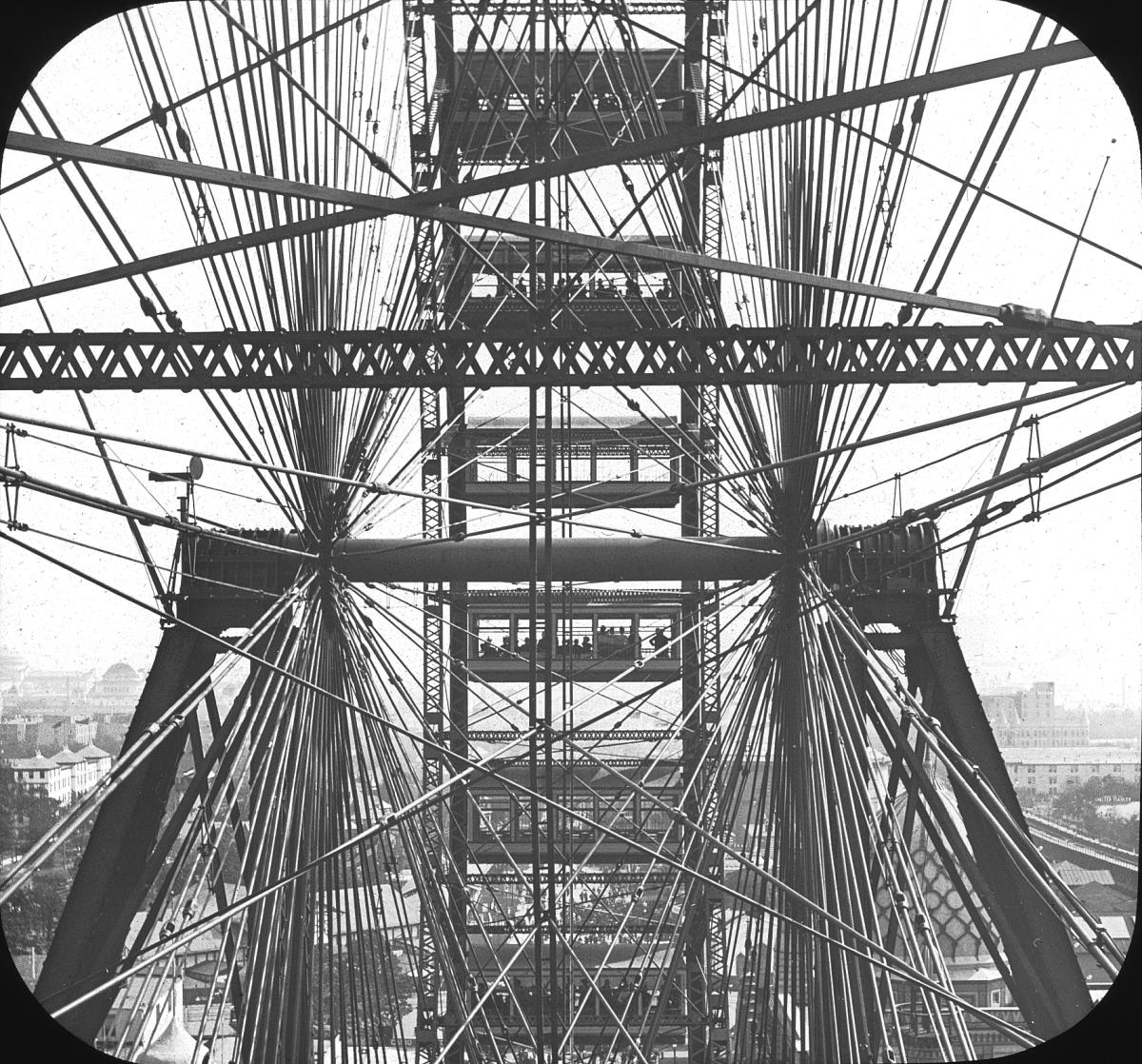
| Structure | A steel tension wheel built like a bicycle wheel, with rods in tension rather than rigid spokes in compression. Rice gives the rods as 2-9/16 inches; Weingardt, and the 18 June Tribune, give 2½ inches.[1, p. 74][1, p. 107][2, p. 477][3, pp. 615–616][9, p. 25] |
| Axle | A forged-steel axle about 45 feet long, reported at shipment as 33 inches in diameter and 89,320 pounds (Weingardt gives 32 inches and about 45 tons), described then as the largest piece of steel yet forged in the country.[1, p. 74][1, p. 83][2, p. 477][3, p. 616][10, p. 2][11, p. 576] |
| Cars | Thirty-six enclosed cars. Contemporary descriptions disagree on capacity: some give forty seats each, others sixty (forty seated plus standing), or 2,160–2,260 total.[1, p. 126][1, p. 92][2, pp. 475–480][5, p. 8][8][11, pp. 274, 576–577][12, Item 8] |
| Power | Driven by steam engines with a Westinghouse air brake, through endless chains at the rims; Barrett, the fair’s electrician, placed the boiler and dynamo plant 700 feet outside the grounds.[1, p. 83][1, p. 107][13, pp. 19–21] |
| Lighting | Barrett: 1,540 lamps on the Wheel and 2,900 in all. Press accounts of the 16 June preview round that to “more than 3,000.”[1, pp. 86–88][13, pp. 19–21, 'Lighting of the Ferris Wheel']Weingardt describes that preview, with some 3,000 lights on the structure, quoting the Pittsburgh Commercial Gazette.[1, pp. 86–88] |
| Ride | Fifty cents for two revolutions is independently in the 1893 guidebook and the 18 June Tribune. How long that took is in conflict: Rice has twenty minutes for the double trip; the Tribune expected one revolution every twenty minutes; Searles, after the season, gives nine minutes a revolution.[1, p. 92][1, p. 95][2, p. 479][3, p. 617][9, p. 25][12, Item 8][15] |
| Foundations | The Chicago Citizen of 12 August 1893 dates the start of foundation work to 8 January 1893 and describes thawing quicksand with live steam, matching Rice’s later account.[1, p. 83][2, pp. 475–480][7, p. 5]Rice’s 1901 account, matching that Citizen feature, describes thawing frozen quicksand with live steam to sink the foundations from January 1893.[1, p. 83][2, pp. 475–480][7, p. 5] |
| Fabrication | Rice describes fabrication spread across a dozen shops, with Ferris’s inspectors on the work; Engineering News recorded 2,200 tons put in shape at Detroit.[1, pp. 82–83][2, pp. 475–480][6] |
| Storm test | The Wheel came through a severe storm on 9 July 1893. Syndicated reports said it did not move “a hair’s breadth”; a letter in Engineering News, via Weingardt, gave about an inch and a half of sideways movement.[1, pp. 93–94][6][14, p. 1, syndicated] |
| Axle after 1906 | The axle’s fate is unresolved. One line of evidence, from Chicago House Wrecking Company records, says it was cut up in Chicago around 1919; St. Louis searches in 1943 and 2007 looked for a buried shaft and did not excavate.[1, p. 120][16, pp. 4–9][17, pp. 2–7][18][19, p. 8] |